Ōkuninushi's Making of the Land and the White Hare of Inaba
The kind-hearted Ōkuninushi, who saved the White Hare of Inaba, twice loses his life to the persecution of his eighty brothers, yet is restored by the power of Kamimusuhi no Kami, one of the Three Deities of Creation. The story leads on through the making of the land with Sukunabikona no Kami to the founding of Ōmiwa Jinja, where Ōmononushi no Ōkami is enshrined upon Mount Miwa.
Among the descendants of Susanoo no Mikoto was a god called Ōkuninushi no Kami. He had a great company of brothers, called the Yasogami, the eighty gods, who set out together to woo the beautiful princess of Inaba, Yagamihime. The gentle-hearted Ōkuninushi was made to shoulder a great bag alone, like an attendant, and trudged in silence far behind the rest.
At Cape Keta they came upon a hare, flayed red and naked, weeping upon the ground. The eighty gods who went before had amused themselves by teaching it a false cure — bathe in seawater and lie in the wind upon a high mountain — and the hare's suffering had only grown crueler. When Ōkuninushi, passing later, asked what had happened, the hare told him: "I wished to cross over from the island of Oki, so I tricked the wani (sea-crocodiles), telling them I would count which of our clans was the greater; I made them lie in a row across the sea and leapt across their backs. Just short of the shore I let slip that I had deceived them, and the last wani stripped me of my skin."
Ōkuninushi taught it: "Go quickly to the river mouth and wash your body in fresh water; then scatter the pollen of the kama rushes and roll upon it." The hare did as it was told, and its body was restored. This is the White Hare of Inaba. Rush pollen was used from old times as a salve for wounds, and this scene is called an origin tale of Japanese medicine. The white hare — which the Kojiki records as a hare-deity — declared: "The eighty gods shall not win Yagamihime. You who bear the bag upon your back — it is you who shall win her." As foretold, Yagamihime answered, "It is Ōkuninushi I will wed."
Enraged at this, the eighty gods commanded him at Mount Tema in Hōki, "We will drive a red boar down upon you; you shall catch it," and rolled down a great rock heated in fire to look like a boar. Ōkuninushi caught the rock in his arms and was burned to death. His grieving mother went up to heaven and pleaded with Kamimusuhi no Kami — one of the Three Deities of Creation who had appeared at the beginning of heaven and earth. Kamimusuhi at once sent Kisagaihime and Umugihime, and when the two shell-goddesses gathered the powder of their shells and anointed him with mother's milk, Ōkuninushi came back to life as a comely young man.
Still the eighty gods did not relent, but crushed Ōkuninushi to death in the cleft of a great tree. Saved once more by his mother, he fled to Ne-no-Katasukuni, the far land where Susanoo no Mikoto dwelt. The chamber of snakes; the chamber of centipedes and wasps; fire set upon the open plain. Overcoming each trial laid upon him with the help of Suseribime, Ōkuninushi grew into the great god who would bear the making of the land of Ashihara-no-Nakatsukuni, the Central Land of Reed Plains.
In the midst of the land-making, a tiny god came riding over the waves in the heavenly boat of kagami-vine pods. None knew his name, until Kuebiko, the scarecrow god, revealed it: "He is Sukunabikona no Kami, child of Kamimusuhi no Kami." Kamimusuhi declared, "Truly he is my child. Become brothers with Ōkuninushi, and make and firm that land." The two joined their strength and carried the making of the land forward. But in time Sukunabikona crossed away to Tokoyo-no-Kuni, the everworld beyond the sea.
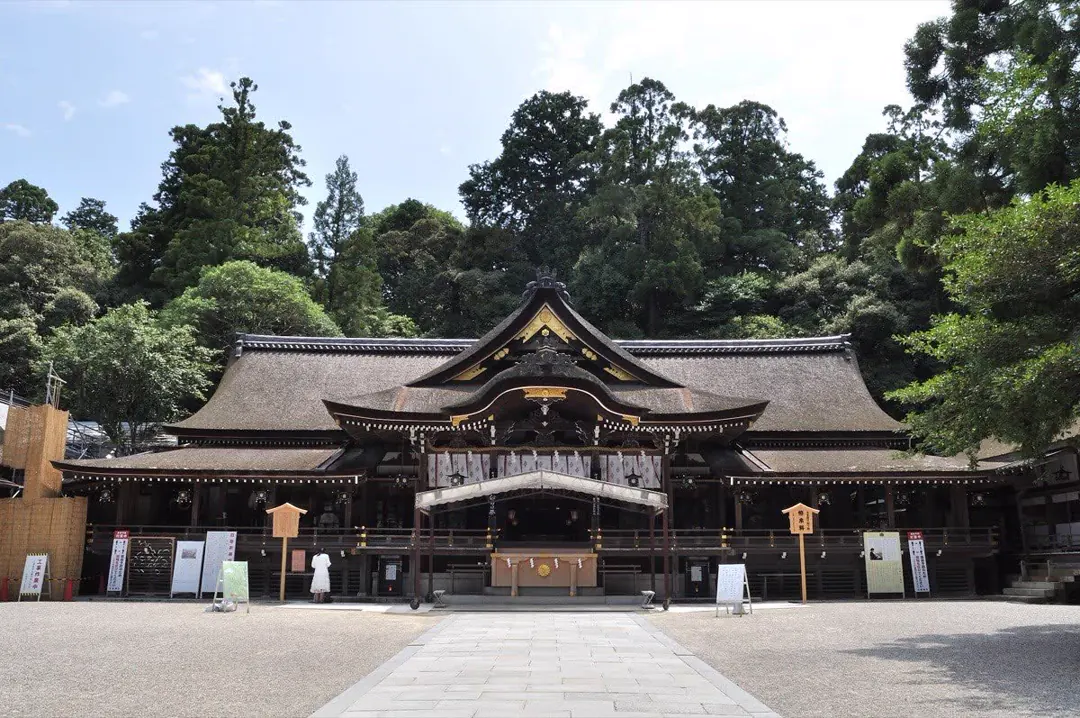
"How am I to make this land alone?" As Ōkuninushi grieved, a god came drawing near, illuminating the sea. "If you will worship me well, I will make the land together with you. Enshrine me upon the mountain to the east, within the green fence of hills that rings Yamato." This god was Ōmononushi no Ōkami, and the eastern mountain where he came to rest is Mount Miwa — held to be the founding of Ōmiwa Jinja. Through the whole path of Ōkuninushi — begun in kindness to a wounded hare, passing through two deaths and two revivals to the completion of a land — the working of Kamimusuhi, the deity who binds life into being, was present at every turn.
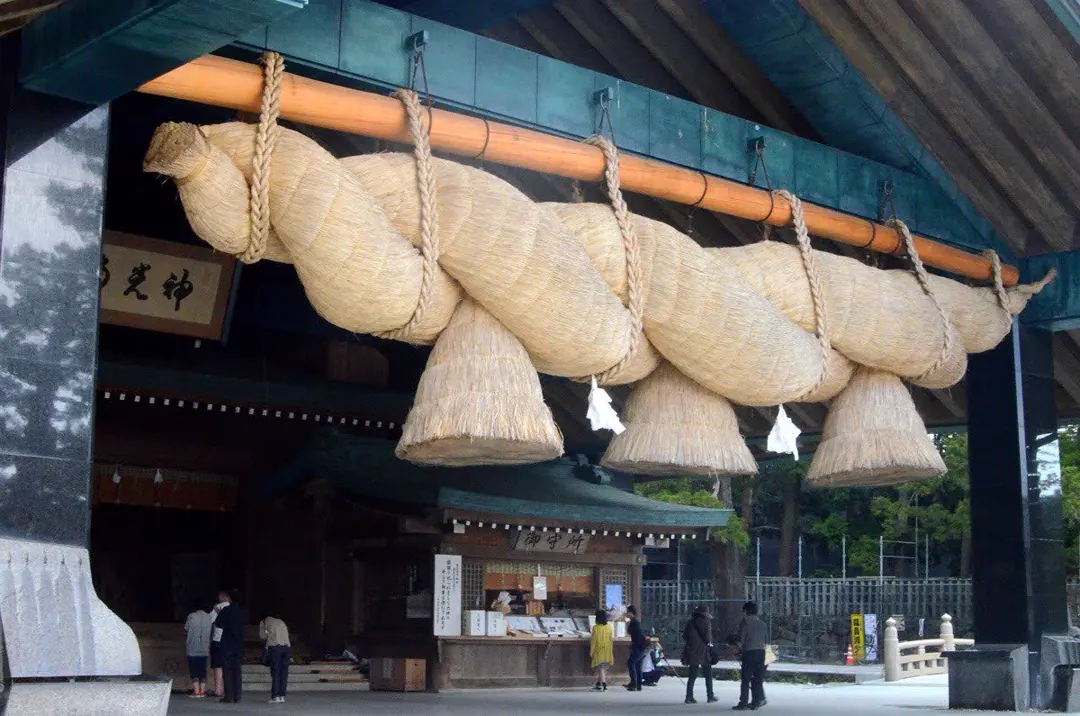
Izumo Taisha, enshrining Ōkuninushi no Ōkami, is the head sanctuary of en-musubi, and many statues of the white hare stand within its precincts. Ōmiwa Jinja enshrines Ōmononushi no Ōkami — who appeared before Ōkuninushi at the impasse of his land-making — with Mount Miwa itself as the divine body, and hands down this myth to the present as the origin of its founding.